Failure to Rescue
What the record should show when a patient begins to deteriorate
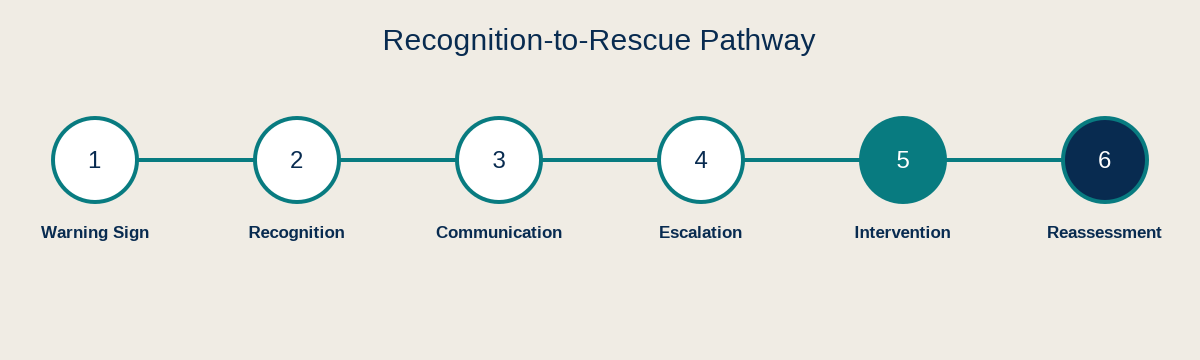
A catastrophic outcome can appear sudden when the record is read backward from the code, emergency transfer, permanent injury, or death. Read forward, the same record may show hours of accumulating warning signs.
AHRQ describes failure to rescue as a failure or delay in recognizing and responding to a hospitalized patient’s serious complication or deterioration. The concept is especially useful because it shifts attention from whether the initial complication was preventable to whether the healthcare system responded effectively after the complication emerged.
For plaintiff counsel, the central questions are direct: When did the patient begin to deteriorate? Who knew—or should have known? What should have happened next? Would timely rescue probably have changed the outcome?
Complications and rescue are separate issues
Not every postoperative bleed, infection, medication reaction, respiratory event, or disease complication results from negligence. But even an unavoidable complication can become a preventable catastrophe if it is not recognized and treated in time.
This distinction matters. A case may be weak on the cause of the original complication yet strong on the delayed response. Conversely, the record may show that deterioration was abrupt, recognized immediately, and treated appropriately, leaving no meaningful rescue opportunity.
The six links in the rescue chain
Detection. Was the patient monitored at an intensity appropriate to the risk? Were vital signs, oxygen saturation, pain, mental status, urine output, laboratory values, wound findings, or device data obtained as required?
Recognition. Did someone identify the pattern as deterioration rather than isolated abnormalities? A single value may be nonspecific; a trend can be unmistakable.
Communication. Was the change communicated clearly to a clinician with authority to act? Did the message include the relevant history, trend, and urgency?
Escalation. If the first response was inadequate, did staff use the chain of command, rapid-response process, emergency services, or transfer pathway?
Intervention. Was the patient examined, tested, treated, moved to a higher level of care, or taken back to the operating room within a clinically meaningful time?
Reassessment. After an intervention, did the team determine whether the patient improved? A treatment order is not the end of the analysis if the patient continued to worsen.
Find the first meaningful warning—not merely the last abnormality
The most dramatic event is rarely the first important event. A code record may be complete while the preceding nursing flowsheets show progressive hypotension, tachycardia, falling oxygen saturation, increasing pain, confusion, low urine output, repeated vomiting, or an expanding wound problem.
The first meaningful warning depends on the clinical context. A change that would be expected after one procedure may be alarming after another. Experts should identify when the pattern crossed from routine recovery or stable illness into a condition requiring reassessment, escalation, or intervention.
Who knew what, and when?
Failure-to-rescue cases often involve fragmented knowledge. The nurse sees a trend. The covering physician receives one value. The surgeon hears a reassuring summary. The family reports that the patient is “not acting right.” The electronic system generates an alert that no one meaningfully reviews.
A strong analysis reconstructs the information available to each participant. It also examines whether the communication method preserved urgency. “Doctor aware” is not enough. What exactly was communicated? At what time? What response was given? Was the response carried out? Did anyone follow up when the patient failed to improve?
Records that commonly matter
Vital-sign flowsheets, nursing assessments, early-warning scores, intake and output, pain assessments, and neurological checks
Telemetry, pulse oximetry, capnography, alarm settings, alarm histories, and central-monitoring records
Medication-administration records, infusion data, oxygen delivery, reversal agents, and rescue medications
Laboratory and imaging order times, performance times, preliminary results, final results, and notification records
Pages, secure messages, telephone logs, consult requests, handoff tools, and chain-of-command documentation
Rapid-response, code, transfer-center, ambulance, and receiving-facility records
Staffing assignments, patient-to-nurse ratios, float assignments, and supervision records
Policies for postoperative monitoring, escalation, rapid response, physician notification, and emergency transfer
The rescue window and causation
The existence of warning signs does not establish that rescue was medically possible. Causation depends on the complication, the patient’s baseline condition, the available interventions, and the point at which the injury became irreversible.
The expert should identify the rescue window: the period during which appropriate recognition and treatment probably would have prevented death, permanent injury, or a substantial worsening. That may involve earlier antibiotics, fluid resuscitation, reversal medication, imaging, transfusion, airway support, intensive monitoring, surgery, or transfer.
Common defense explanations
The deterioration was sudden and unforeseeable.
The abnormal findings were expected, nonspecific, or clinically insignificant at the time.
The team responded appropriately, but the patient’s condition was not survivable or reversible.
The patient’s comorbidities, frailty, or treatment limitations—not delay—determined the outcome.
The clinician was not given accurate or complete information.
The patient or family declined recommended escalation or treatment.
The timeline should test each explanation. A claimed sudden event may be preceded by an escalating trend. A claimed appropriate response may be an order without reassessment. A communication defense may shift attention to the nurse, covering clinician, chain of command, or facility system.
Questions for experts and witnesses
What was the first clinically meaningful sign of deterioration?
What monitoring should have occurred for this patient’s risk profile?
Who received each warning, and what did they understand?
When should the chain of command or rapid-response process have been activated?
What intervention was available during the rescue window?
Would timely intervention probably have prevented or reduced the injury?
Practical takeaways for plaintiff counsel
Analyze the hours before the catastrophe, not only the catastrophe itself.
Treat trends, communications, escalation, and reassessment as separate parts of the case.
Identify the person and system responsible at each link in the rescue chain.
Ask experts to define the rescue window and the intervention that would have mattered.
Consider whether staffing, monitoring, facility capability, or transfer systems contributed to the failure.
Failure to rescue is often visible only after the record is reorganized around deterioration. The decisive story is not simply that the patient became critically ill. It is whether the system recognized the danger, responded with urgency, and used the opportunity it had to prevent a worse outcome.
Recognition-to-Rescue Window
Effective intervention depends on recognizing the warning sign while a meaningful rescue opportunity remains.
Warning
Deterioration begins
Recognition
Pattern becomes visible
Rescue Window
Intervention can still matter
Irreversible Harm
Opportunity closes
Selected Sources
1. Agency for Healthcare Research and Quality, Patient Safety Network, Failure to Rescue
2. Agency for Healthcare Research and Quality, Patient Safety Network, Rapid Response Systems
3. AHRQ Patient Safety Network, Despite Clues, Failed to Rescue
For Attorney Use
This article identifies medical, documentary, and case-development issues for counsel’s consideration; counsel remains responsible for all legal analysis and decisions.
Disclaimer
This article is provided for general informational and educational purposes only. Nothing in it constitutes medical or legal advice, and it should not be relied upon as a substitute for advice from qualified healthcare professionals or legal counsel concerning any specific patient, claim, or matter. Medical standards, laws, and legal requirements may vary by jurisdiction and circumstances. Monica Berlin is a medical litigation consultant and does not provide legal services or legal opinions.
© 2026 Monica Berlin. All Rights Reserved.
Let’s Connect
Whether you’re evaluating a potential case or simply exploring whether we’re a good fit, I’d welcome the opportunity to talk.
Let’s Connect