From Bad Outcome to Viable Claim
Testing breach, causation, damages, and case coherence
A devastating medical outcome deserves careful investigation. It does not automatically establish a viable malpractice claim.
Some injuries are recognized complications of reasonable care. Some apparent errors did not cause the outcome. Some cases contain a meaningful breach but insufficient damages. Others begin with a narrow allegation and become stronger only after the records reveal a different failure, an additional responsible party, or a more coherent causal sequence.
The purpose of early medical case screening is not to prove the case. It is to determine whether the facts support further investment—and to identify the questions that must be answered before counsel commits substantial time and resources.
My job is not to confirm a theory. It is to test the medical facts, identify strengths and weaknesses, and tell counsel what the record supports.
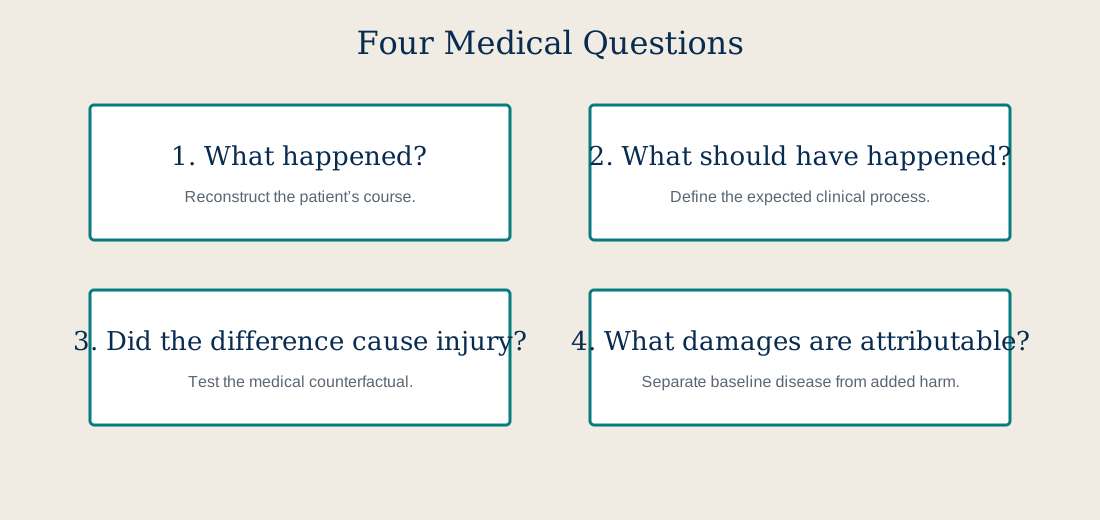
The four medical questions
What happened? Reconstruct the patient’s baseline condition, presenting problem, course of care, complication, injury, and subsequent treatment. Separate documented facts from assumptions and disputed accounts.
What should have happened? Identify the reasonable clinical process for this patient at this time and in this setting. This may involve diagnosis, monitoring, consent, treatment, follow-up, staffing, escalation, or facility systems.
Did the difference cause the injury? Define the counterfactual. If appropriate care had occurred, what probably would have been different? A breach without a medically supportable causal pathway may not sustain the claim.
What damages are attributable to the alleged failure? Distinguish harm caused by the underlying disease or preexisting condition from additional harm caused by delay, treatment, or system failure.
A six-part screening framework
Clarity of the departure. Is there a specific act or omission that can be evaluated? “The care was terrible” is not a medical theory. “The abnormal pathology result was not communicated or followed for eight months” is.
Strength of causation. Can the injury be connected to the alleged departure through a medically plausible and evidence-supported sequence? How strong are the alternative causes?
Magnitude and durability of damages. What additional treatment, disability, pain, lost function, financial loss, or risk resulted? Are the damages temporary, permanent, or uncertain?
Quality of the evidence. Are the relevant records available, complete, and internally coherent? Are there objective data, images, laboratory results, device records, witnesses, or admissions that support the theory?
Expert support. What specialties are required to address breach and causation? Is the proposed theory within the expert’s actual clinical experience? Will experts agree on the critical point?
Case coherence. Can the case be explained in a clear sequence that connects the patient’s condition, the missed opportunity, the responsible person or system, and the resulting harm?
Do not confuse a guideline with the whole standard
Guidelines, policies, checklists, accreditation standards, and professional statements can provide useful evidence of expected processes. They should be applied with care.
A guideline may allow clinical judgment, contain exceptions, or have been updated after the care at issue. A facility policy may be stricter than common practice or unrelated to the injury. Conversely, customary practice may still be unsafe. The medical analysis should focus on why the proposed action was appropriate for this patient under the circumstances—not merely whether a document contains the same instruction.
Test the defense theory early
A strong plaintiff review should identify the best defense explanation before the defense does. That is not pessimism. It is case discipline.
Common alternatives include an unavoidable complication, atypical presentation, rapidly progressive disease, poor prognosis despite timely care, patient nonadherence, reasonable clinical judgment among competing options, or injury caused by an unrelated condition.
The question is not whether an alternative explanation exists. Most complex cases have several. The question is which explanation best fits the complete record, objective data, timing, and medical science.
When several small failures become one coherent case
Medical harm often results from accumulation rather than one dramatic error. A patient may receive an incomplete assessment, an abnormal result may be routed poorly, a referral may not be scheduled, and a return visit may fail to integrate the earlier information. Each event alone may appear modest. Together they may show a broken diagnostic process.
The same is true in surgery and postoperative care. Consent may be incomplete, a risk may not be optimized, monitoring may be inadequate, and deterioration may not be escalated. The case theory should identify how the failures interacted rather than presenting a disconnected list of criticisms.
When the review should narrow, expand, or stop the case
Narrow the case when the records support one clear failure but not the broader allegations.
Expand the case when the evidence identifies additional responsible clinicians, facility systems, consent issues, or later failures that materially contributed to harm.
Reframe the case when the original theory is weak but a different medical sequence is better supported.
Stop or defer the case when causation is speculative, the injury is not attributable to the alleged conduct, essential evidence is unavailable, or qualified experts do not support the theory.
Seek additional records before deciding when the current production is incomplete or the chronology depends on information held in another system.
Records and analyses that improve early screening
A focused chronology that highlights decision points rather than reproducing every encounter
A problem list separating undisputed facts, disputed facts, missing evidence, and expert questions
A comparison of the patient’s actual course with the medically expected course
A causation map linking each alleged departure to a specific injury mechanism
A responsible-party map showing who controlled each critical decision or system
A damages summary distinguishing baseline disease from additional harm
A list of the strongest defense explanations and the evidence that supports or weakens each
Questions for experts
What is the most specific medically supportable departure?
What facts would change your opinion?
What alternative explanation is strongest?
What intervention would appropriate care have produced, and by when?
What injury was probably avoidable or less severe?
Are additional specialties needed to address causation, prognosis, or facility systems?
Practical takeaways for plaintiff counsel
Start with a medical theory that can be stated in one or two precise sentences.
Require breach, causation, and damages to connect; do not evaluate them in isolation.
Identify and test the strongest defense theory early.
Distinguish a bad outcome, a documentation problem, and a causative medical failure.
Use early screening to decide whether to narrow, expand, reframe, investigate further, or decline the case.
The best early review is not the one that finds the most criticisms. It is the one that identifies the strongest medically coherent theory, exposes its weaknesses, and gives counsel a disciplined basis for the next decision.
Selected Sources
1. Agency for Healthcare Research and Quality, Patient Safety Network, Diagnostic Errors
2. National Academies of Sciences, Engineering, and Medicine, Improving Diagnosis in Health Care
4. Office of the National Coordinator for Health Information Technology, SAFER Guides
For Attorney Use
This article identifies medical, documentary, and case-development issues for counsel’s consideration; counsel remains responsible for all legal analysis and decisions.
Disclaimer
This article is provided for general informational and educational purposes only. Nothing in it constitutes medical or legal advice, and it should not be relied upon as a substitute for advice from qualified healthcare professionals or legal counsel concerning any specific patient, claim, or matter. Medical standards, laws, and legal requirements may vary by jurisdiction and circumstances. Monica Berlin is a medical litigation consultant and does not provide legal services or legal opinions.
© 2026 Monica Berlin. All Rights Reserved.
Let’s Connect
Whether you’re evaluating a potential case or simply exploring whether we’re a good fit, I’d welcome the opportunity to talk.
Let’s Connect