How secure are your doctor’s medical record-keeping practices? Here’s what you need to know.

Why This Matters
This article examines a patient-safety issue that may also reveal important clinical, documentation, operational, or accountability questions. Careful attention to these details can help patients and attorneys understand what happened—and what should have happened.
In this post, I’m going to describe the risks you face if you visit a doctor that still writes notes by hand and keeps paper records or uses an electronic health record (EHR) system that isn’t certified (and might even have been developed in-house). Holdouts that have resisted making the transition to gold standard certified EHR systems are typically doctors in small, independent practices that don’t accept Medicare.1
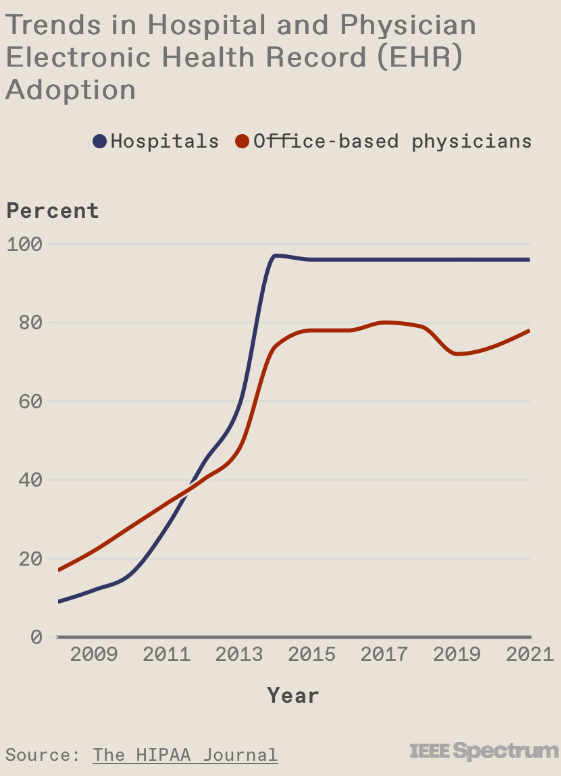
Of course, doctors hate using EHRs, as they decrease face-to-face time with patients. But this train left the station long, long ago. Today, four out of every five office-based physicians have adopted certified EHRs which provide the highest degree of security and integrity.2
Paper records (and most non-certified EHRs) pose a number of concerns for patients. Most obviously, paper charts can get lost or stolen, and doctors rarely keep backups. And if you’re interested in learning more about how easy it is for cybercriminals to hack non-certified EHRs, here’s a TV news interview I recently did on this subject.
But there are plenty of other ways that paper records and non-certified EHRs can cause problems. For instance:
- It’s easier to make errors or illegible notations in paper records, which are not often caught or corrected.
- Paper records (and non-certified EHRs) are not as secure as certified EHRs, as they can be viewed, copied or stolen by anyone with access. (In a certified EHR system, unauthorized access would be flagged as a data breach and forensic investigations could unmask the perpetrator.)
- Paper records (and non-certified EHRs) can be tampered with after the fact to cover up medical errors. In a certified EHR, it’s harder for a miscreant doctor to cover his tracks.
The final bullet above is worth pondering. While falsifying a medical record is a crime, it is not illegal for medical professionals to make honest updates to records as long as these notes are labeled as such.3 As a result, proving that a record has been tampered with is a difficult challenge.
“Falsification and tampering come in many forms – removing a diagnostic report, inserting information without standard documentation, rewriting or destroying the record, omitting significant facts, or even creating records for nonexistent patients or staff.”
— MedLaw Advisory Partners (Source)
Record falsification does happen in healthcare. Shady doctors might be tempted to tamper with a patient chart to cover up an error or whitewash an adverse medical outcome, especially if they’ve been sued by a patient claiming injury. As a patient, if your doctor is still using paper records (or a home-grown EHR that isn’t certified for Medicare use) ask for copies of your notes immediately after your visit and pay special attention to any suspicious addendums or markings.
It goes without saying that the vast majority of physicians that still use paper records are honest, caring professionals. Nevertheless, as I usually say at the end of my posts, trust but verify.
Footnotes
1 Centers for Medicare & Medicaid Services, “Certified EHR Technology.” (Source)
2 The Office of the National Coordinator for Health Information Technology, “Office-based Physician Electronic Health Record Adoption. (Source)
3 “Alteration of Medical Records,” Miller & Zois. (Source)
Disclaimer
This article is provided for general informational and educational purposes only. Nothing in it constitutes medical or legal advice, and it should not be relied upon as a substitute for advice from qualified healthcare professionals or legal counsel concerning any specific patient, claim, or matter. Medical standards, laws, and legal requirements may vary by jurisdiction and circumstances. Monica Berlin is a medical litigation consultant and does not provide legal services or legal opinions.
© 2026 Monica Berlin. All Rights Reserved.
Let’s Connect
Whether you’re evaluating a potential case or simply exploring whether we’re a good fit, I’d welcome the opportunity to talk.
Let’s Connect